Clothing Certification in 2025: What Gets Checked
Fabric composition drives which tests apply, the label is the product's passport, and a lab discrepancy means no certificate, plus fines for false labelling.
Textile certification is mostly a chemistry and labelling exercise: what is in the fabric, and what the label says about it. In the EU that means REACH Regulation (EC) 1907/2006 Annex XVII for restricted substances and Regulation (EU) 1007/2011 for fibre names; in the Eurasian Economic Union it is TR CU 017/2011; in the US it is 16 CFR Part 1610 for flammability plus CPSIA for anything sold for children. Adult garments are declared in most markets. Childrenswear is a safety category with its own cord, small-parts and flammability tests, and the Eurasian regime certifies its first layer.
The same short list comes back in every market. Under REACH Annex XVII, entry 43 bans azo dyes that release any listed aromatic amine above 30 mg/kg, entry 27 caps nickel release from studs, zips and buttons at 0.5 µg/cm² per week, entry 47 limits chromium VI in leather to 3 mg/kg, and entry 72 (added by Regulation (EU) 2018/1513) sets 75 mg/kg for formaldehyde in clothing. Entry 51 caps four phthalates at 0.1 % in plasticised prints and coatings. The azo test itself is EN ISO 14362-1. TR CU 017/2011 runs a parallel list with formaldehyde limits by layer. The US has no general chemical list for adult clothing; CPSIA supplies one only for children's products, with total lead at 100 ppm.
Testing is per material and per colourway. A range of twelve styles in four colours may need far fewer tests than it appears, or far more, depending entirely on how many distinct fabrics, dyes and trims sit underneath. Get the material list right first. The budget follows from it.
In the EU, Regulation (EU) 1007/2011 fixes the fibre names you may use and requires the composition in the official language of the country of sale, using the names in its Annex I and nothing else: "Lycra" is a trademark, "elastane" is the fibre name. Footwear is labelled by component under Directive 94/11/EC: upper, lining and sock, outer sole. Care symbols are voluntary in the EU and compulsory in the US under 16 CFR Part 423. Country of origin is a customs matter that the label still has to get right.
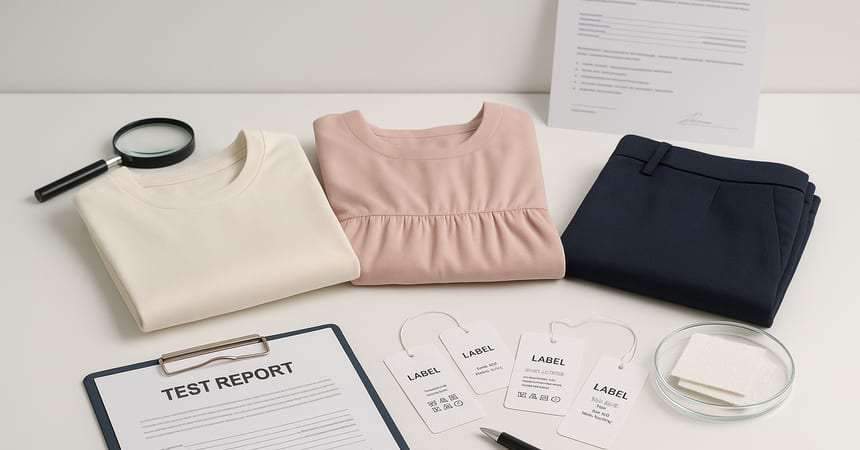
Labels are printed late and cheaply, and that is exactly why they hold shipments. Send the artwork for review before the label order goes out.
Three things change. EN 14682 restricts cords and drawstrings on clothing for children up to 14: no functional cords at all in the hood and neck area below age seven, and length and free-end limits above it. Small parts and flammability are assessed, and the chemical limits tighten. In the Eurasian Economic Union children's clothing leaves TR CU 017/2011 altogether and sits under TR CU 007/2011, which takes first-layer garments and anything for children under one year into certification; the second and third layers are declared.
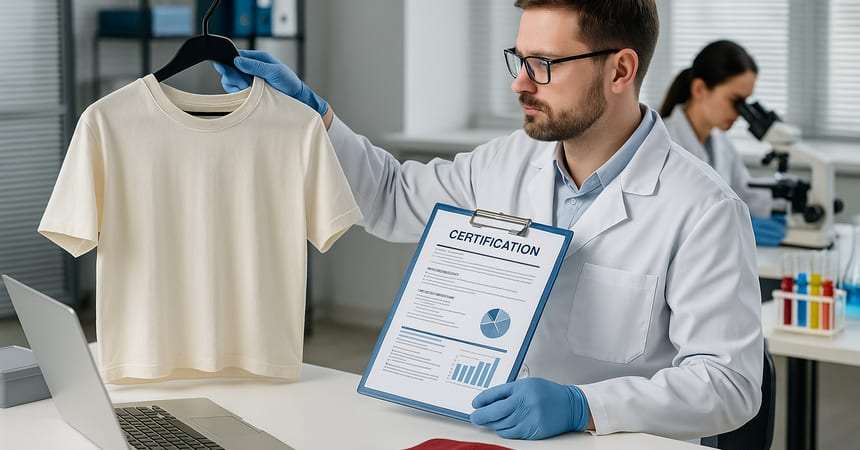
The document changes with it. A declaration is your own signature on your own evidence. A certificate means an accredited body listed by Rosakkreditatsiya tests its own samples and signs next to you. Treating the children's range as a smaller version of the adult range misses both the tests and the document.
TR CU 017/2011 covers 39 positions of light-industry products for adults, and five of them are certification-only. The line is skin contact. First-layer goods, meaning underwear, hosiery, bed linen and anything else worn directly on the skin, are certified. The second and third layers get the same declaration, so a lined coat and the jacket under it take one route. Footwear and leather goods are declared.
Footwear adds chromium VI in leather, the substance most often failed in this group, and solvent residues from adhesives. Safety footwear is not footwear for this purpose. It is personal protective equipment under Regulation (EU) 2016/425, tested to EN ISO 20345 and certified by a notified body, and it belongs in a separate project with its own timeline.
16 CFR Part 1610 classifies clothing textiles by burn time and exempts plain-surface fabrics of 88.2 g/m² or heavier and fabrics made entirely of acrylic, modacrylic, nylon, olefin, polyester or wool, which removes most adult garments from testing. Children's sleepwear has its own standards, 16 CFR 1615 and 1616. CPSIA then adds, for anything designed for children twelve and under, third-party testing at a CPSC-accepted laboratory, a Children's Product Certificate and a tracking label. Adult clothing needs none of that.
| Requirement | Adult clothing | Childrenswear | Footwear |
|---|---|---|---|
| Restricted chemicals | REACH Annex XVII entries 27, 43, 51, 72; TR CU 017/2011 | Same, plus CPSIA lead 100 ppm in the US | Plus chromium VI, 3 mg/kg (entry 47) |
| Fibre or material labelling | Regulation (EU) 1007/2011 | Regulation (EU) 1007/2011 | Directive 94/11/EC, by component |
| Care labelling | Voluntary in the EU; 16 CFR Part 423 in the US | Same | Not required |
| Cords and small parts | Not assessed | EN 14682, up to age 14 | Not assessed |
| Flammability | 16 CFR 1610, most fabrics exempt | 16 CFR 1610; sleepwear 1615 and 1616 | Rarely |
| Document in the EAEU | TR CU 017/2011: certificate for first layer, declaration otherwise | TR CU 007/2011: certificate for first layer and under one year | TR CU 017/2011 declaration; PPE is certified |
Everything on the left is something to find before the project starts. Everything on the right is ours. Send what you have and we will tell you what is missing.
You provide
We provide
Every material does; every garment does not. Testing is organised by material and colourway, so a range sharing fabrics and dyes needs far fewer tests than its style count suggests. Build the test matrix from the bill of materials and count the trims: a metal button is a nickel-release sample in its own right.
Because regulators treat it as a safety product. EN 14682 restricts cords and drawstrings up to age 14, small parts and flammability are assessed, and chemical limits tighten. In the Eurasian Economic Union it moves to TR CU 007/2011, where first-layer garments are certified by an accredited body instead of declared, and in the US CPSIA adds third-party testing and a Children's Product Certificate.
Azo dyes releasing restricted amines above 30 mg/kg, formaldehyde in finishes, nickel release from fastenings above 0.5 µg/cm² per week, and chromium VI in leather. Most of it is inherited from the dyehouse or the tannery. Collect supplier declarations before testing, and ask the mill for its own EN ISO 14362-1 report on the exact colourway.
No. Safety footwear is personal protective equipment under Regulation (EU) 2016/425, tested to EN ISO 20345 and certified by a notified body, with its own marking. Planning it alongside a fashion range underestimates both the timeline and the documents. Treat the two as separate projects.
Fabric composition drives which tests apply, the label is the product's passport, and a lab discrepancy means no certificate, plus fines for false labelling.
How many samples, in what state, with what composition data and what labelling, the four preparation areas that decide whether testing passes first time.
Skin contact decides the document. First-layer products certify, second and third layer declare, and the layer follows from intended use, not from the fabric.
One specialist owns your file from the first email to the registered certificate. Every one of them has recorded a briefing on their field.
Send the product name, HS code and technical data. You get back the applicable route, the document list and a timeline, before any commitment.
Scoping is freeReply within one working day