Preparing Clothing for Laboratory Testing: A Checklist
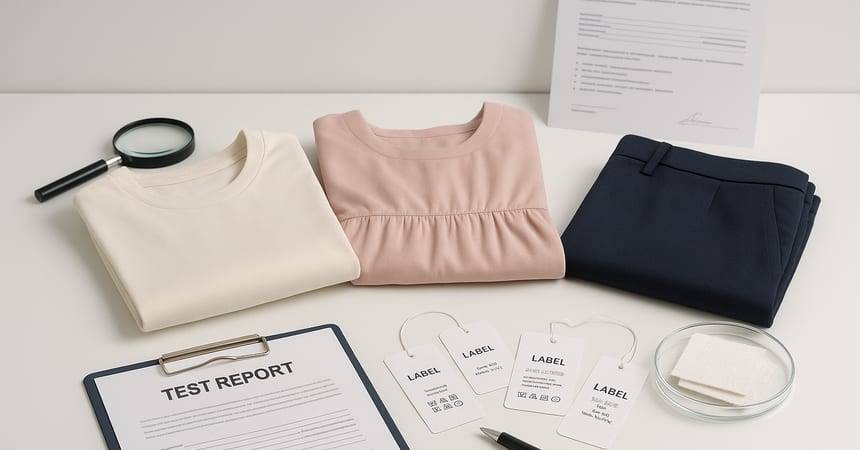
Testing begins before the samples reach the laboratory. The laboratory assesses actual garments, so the samples must be finished, unworn and unwashed, the composition must be exact down to lining and thread, and the labelling must be complete and in the Union's working language.
Samples: what exactly do you provide?
The laboratory assesses actual clothing samples, and those samples are the basis for the test protocol results.
- Prepare 1 to 2 units of each model, t-shirts, dresses, trousers.
- Samples must be fully finished and ready for sale: with seams, fittings, labels and trims.
- Use items that have not been worn or washed, taken directly from production or a finished batch.
If you want several models on one certificate, a t-shirt and a long-sleeve, say, discuss it with the certification body in advance. You may need to provide the highest-risk model: the one with the most complex fabric or design.
Composition: the facts must match the declaration
Discrepancies between declared and actual composition are one of the most common reasons certification fails. To avoid it:
- Verify the exact fibre content percentages, 95% cotton, 5% elastane
- Specify raw material names according to GOST, which the documentation depends on
- Account not only for the main fabric but for lining, trims, threads and fittings
Even 3 to 5% synthetic fibre can change which tests are required, or which regulation applies. A preliminary check is cheaper than redoing the process.
Labelling: what must every item carry?
Every item must carry:
- Product name, “Women’s summer trousers”
- Exact material composition
- Size labelling
- Care symbols and text
- Country of origin
- Manufacturer or importer name
- The EAC mark, where the product falls under TR CU regulations
Labelling must always be in the Union’s working language, including for imported products. Violations here lead to outright rejection rather than a request for correction.
Documentation and packaging
Easy to underrate, and inspected, especially for imported goods:
- Packaging that is safe, sealed and free from toxic substances
- A product passport or user manual, where the regulation requires one
- The contract with the manufacturer, shipping documents, invoice and delivery notes, particularly for international imports
A single missing document can mean certification denial or testing delay.
The principle behind the checklist
Everything above is decided before the parcel is sealed. The laboratory does not correct a sample, complete a label or infer a composition. It tests what arrives against what was declared, and any gap between the two counts as a failure.
Sources
- TR CU 017/2011, On the safety of light industry products, Eurasian Economic Commission
- TR CU 007/2011, On the safety of products intended for children and adolescents
- GOST standards for raw material naming and textile test methods
Frequently asked questions
How many samples are needed, and in what state?
One to two units of each model. They must be fully finished and ready for sale, with seams, fittings, labels and trims, and unworn and unwashed, taken directly from production or a finished batch.
Does composition include the lining and trims?
Yes. The exact fibre percentages are needed for the main fabric and also for the lining, trims, threads and fittings. Even 3 to 5% of synthetic fibre can change which tests are required or which regulation applies, so a partial breakdown can send the sample to the wrong tests.
Can several models go on one certificate?
Sometimes, discuss it with the certification body in advance. You may be asked to provide the highest-risk model, meaning the one with the most complex fabric or construction, since that is what the assessment will be pinned to.
Not sure which of these applies to your product? Send it and we will tell you
Related articles
Clothing Certification in 2025: What Gets Checked
Fabric composition drives which tests apply, the label is the product's passport, and a lab discrepancy means no certificate, plus fines for false labelling.
TR CU 017 Testing: Why Clothes Cannot Use Foreign Reports
Adult clothing must be tested in the EAEU, one failed test fails the product, and a composition that does not match the declaration fails by construction.
Sending Clothing Samples for EAC Testing: Three Rules
The invoice fields that keep samples under the customs threshold, the label every item needs, and why the courier choice can sink the registration.