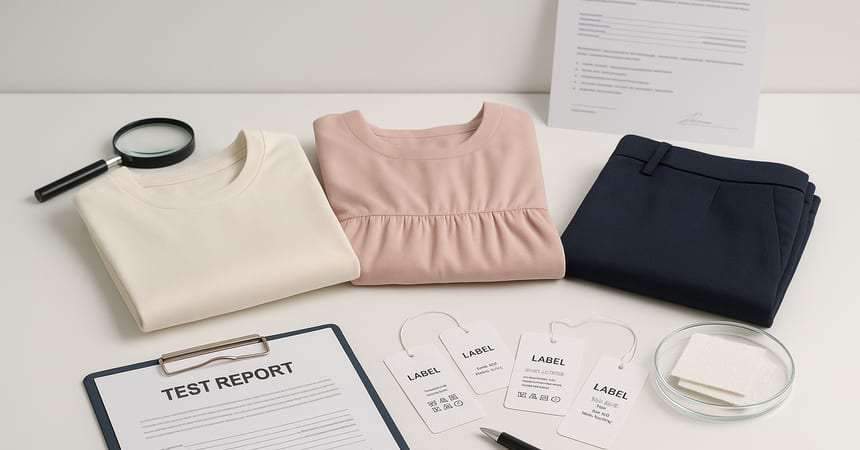
Clothing Certification in 2025: What Gets Checked

Fabric composition decides which tests apply and against which standards. A discrepancy between declared and actual composition means no certificate of conformity, and false labelling can bring fines on top.
Why does fabric composition decide the tests?
The chemical composition of the fabric determines which tests are applied and which standards the item is evaluated against.
| Material | What it means for testing |
|---|---|
| 100% cotton | Usually straightforward, easy to inspect, considered safe |
| Synthetics, polyester, elastane, nylon | Toxic substance testing required |
| Blended fabrics | Exact percentage breakdown of each component required |
If laboratory analysis reveals a discrepancy between the declared and the actual composition, no certificate of conformity is issued. False labelling can also bring fines from the regulatory authorities, so the consequence runs beyond a failed application.
The label is the product’s passport
It exists for transparency and accurate consumer information, and it must include:
- Full composition in percentages
- Intended use, casual, sleepwear, sportswear and so on
- Size to the applicable GOST sizing standard
- Care instructions, using GOST or ISO symbols
- Country of origin, and manufacturer or importer details
- The EAC mark, where certified under EAEU technical regulations
The common failures are mundane and fatal: missing information in the Union’s working language, incorrect care symbols, or a forgotten EAC mark. High-quality products are rejected on these when nothing about the garment is wrong, which is the frustrating part.
What does the laboratory assess?
| Assessment | Covers |
|---|---|
| Fabric composition | Whether the sample matches the labelling |
| Physical-mechanical properties | Strength, wear resistance, wash durability |
| Chemical safety | Absence of formaldehyde, heavy metals, surfactants |
| Hygienic standards | Especially strict for children’s clothing, even dye and vapour migration are checked |
That last row is why children’s clothing is a materially harder project than adult clothing.
What should you check before sending samples?
Three checks, all cheaper than a repeat:
- The accuracy of the composition and whether it matches the product category
- Label compliance with GOST and the TR CU regulations
- Which samples to send, so you are not paying for tests the product does not need
Preparation is the whole game here. The more accurately samples and documents are prepared, the faster the process, and the difference between passing first time and repeating is decided before anything reaches the laboratory.
Sources
- TR CU 017/2011, On the safety of light industry products, Eurasian Economic Commission
- TR CU 007/2011, On the safety of products intended for children and adolescents
- GOST and ISO standards for textile care symbols and test methods
Frequently asked questions
Why does fabric composition determine the tests?
Because different materials need different approaches. 100% cotton is usually straightforward. Synthetics, polyester, elastane, nylon, require toxic substance testing. Blended fabrics need exact percentage breakdowns of each component before the right test programme can be set.
What happens if the composition does not match?
No certificate of conformity is issued. A laboratory analysis revealing a discrepancy between declared and actual composition ends the assessment, and false labelling may bring fines from the regulatory authorities on top of the failed certification.
What must appear on the label?
Full composition in percentages; intended use, such as casual, sleepwear or sportswear; size to the applicable GOST sizing standard; care instructions using GOST or ISO symbols; country of origin and manufacturer or importer details; and the EAC mark where the product is certified under EAEU technical regulations.
Not sure which of these applies to your product? Send it and we will tell you
Related articles
Preparing Clothing for Laboratory Testing: A Checklist
How many samples, in what state, with what composition data and what labelling, the four preparation areas that decide whether testing passes first time.
TR CU 017 Testing: Why Clothes Cannot Use Foreign Reports
Adult clothing must be tested in the EAEU, one failed test fails the product, and a composition that does not match the declaration fails by construction.
TR CU 017 Layers: Which Approval Your Garment Needs
Skin contact decides the document. First-layer products certify, second and third layer declare, and the layer follows from intended use, not from the fabric.