Six Mistakes Registering Supplements in Morocco
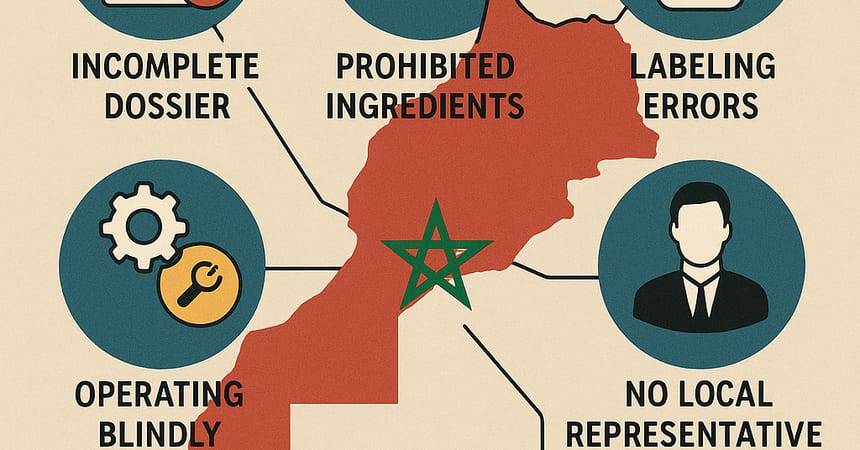
Companies unfamiliar with Morocco make the same mistakes and lose the same time: an incomplete dossier, ingredients that are legal elsewhere and banned there, labels carrying medical claims, no local representative, missing halal documentation, and a timeline set at weeks when the reality is months.
1. Submitting an incomplete dossier
The mistake. Assuming a standard Certificate of Analysis and a label are enough.
The reality. Moroccan regulators require a full dossier: ingredient specifications, certificates of origin, manufacturing protocols, safety documentation, and French translations of all materials.
The fix. Prepare documents to ONSSA and DMP requirements, and use local consultants or a regulatory representative.
2. Prohibited or controversial ingredients
The mistake. Including substances permitted in the EU or USA but banned in Morocco:
- Melatonin
- DHEA
- Synephrine
- CBD or hemp extracts
- Non-certified gelatin
The fix. Cross-check every component against Moroccan and Islamic standards. Obtain halal certification for animal-derived ingredients, and use plant-based alternatives where possible.
This is the mistake that costs the most when discovered late, because the answer is reformulation rather than paperwork.
3. Labelling errors
The mistake. Poor translation; missing required statements; medical claims such as “heals” or “treats”; English-only packaging; no importer address.
The fix. Label in both French and Arabic, remove medical claims, and include full contact information and dosage instructions.
Medical claims are the trap here. A claim that reads as ordinary marketing in one market reclassifies the product as a pharmaceutical in another.
4. No local representative
The mistake. Trying to register without a Moroccan legal entity.
The result. Application rejection, or customs delays.
The fix. Contract a local agent or distributor, or use a professional regulatory representative.
5. No halal certification
The mistake. Submitting products containing gelatin or collagen without halal documentation.
The result. Registration rejection, or refusal by retailers.
The fix. Review ingredients for animal content, and obtain halal certification from an accredited body, Moroccan or an internationally recognised certifier.
6. Underestimating timelines
The mistake. Expecting registration to take two to three weeks.
The reality. Even a complete dossier can take up to four months.
The fix. Plan ahead, submit documents early, and be ready to respond to regulator inquiries. The queries are a normal part of the process, and a slow response to one adds weeks.
What do the six have in common?
Five of these six are decided before submission and discovered after it. The exception is the timeline, which is decided by whoever sets the launch date, and the launch date tends to be set before anyone asks how long the regulator takes.
Sources
- ONSSA, Office National de Sécurité Sanitaire des Produits Alimentaires, Morocco
- DMP, Direction du Médicament et de la Pharmacie
- IMANOR, Institut Marocain de Normalisation
Frequently asked questions
Which ingredients are banned in Morocco but allowed elsewhere?
Melatonin, DHEA, synephrine, CBD and hemp extracts, and non-certified gelatin are all substances permitted in the EU or USA that are prohibited or problematic in Morocco. Cross-checking every component against Moroccan and Islamic standards is the only reliable way to find these before submission.
What goes wrong with labelling?
Poor translation, missing required statements, medical claims such as 'heals' or 'treats', English-only packaging, and no importer address. Labels have to be in both French and Arabic, with medical claims removed and full contact information and dosage instructions present.
How long does registration take?
Up to four months even with a complete dossier, against the two to three weeks manufacturers commonly expect. Submitting early and being ready to answer regulator queries is what keeps that from becoming six.
Not sure which of these applies to your product? Send it and we will tell you
Related articles
Registering Dietary Supplements in Morocco
Morocco has no separate supplement category, products register as food or as pharmaceuticals. That classification sets the route and the document package.
Halal Certification for Supplements in Morocco
When a supplement needs a halal certificate, which international bodies IMANOR recognises, the documents required, and a 3 to 6 week timeline.
Registering Vitamins and Nutraceuticals in Morocco
No legal definition of nutraceutical exists, so classification decides everything: ONSSA or DMP, three to five months, and a mandatory local representative.