Registering Dietary Supplements in Morocco
Morocco does not treat dietary supplements as a category of their own. A product is classified as food or as a pharmaceutical according to its composition and claimed effects, and that classification determines which authority handles it and which documents the dossier needs.
Who regulates supplements in Morocco?
Dietary supplements in Morocco are regulated by the Ministry of Health and Social Protection (Ministère de la Santé et de la Protection Sociale). ONSSA, the Office National de Sécurité Sanitaire des Produits Alimentaires, may also be involved where the product falls under functional or food categories.
The structural point to understand first: Morocco does not classify dietary supplements as a separate category. Unlike the USA, it treats them either as food products or as pharmaceuticals, depending on composition and claimed effects.
That classification determines the registration pathway, so it is the first question to answer.
Which documents does the dossier need?
- Registration application, in French or Arabic.
- Manufacturer’s certificate, preferably GMP or ISO.
- Chemical and biological specifications, full composition, daily dosage, and the properties of the active ingredients.
- Technical dossier (dossier technique), manufacturing details, quality control methods, storage conditions.
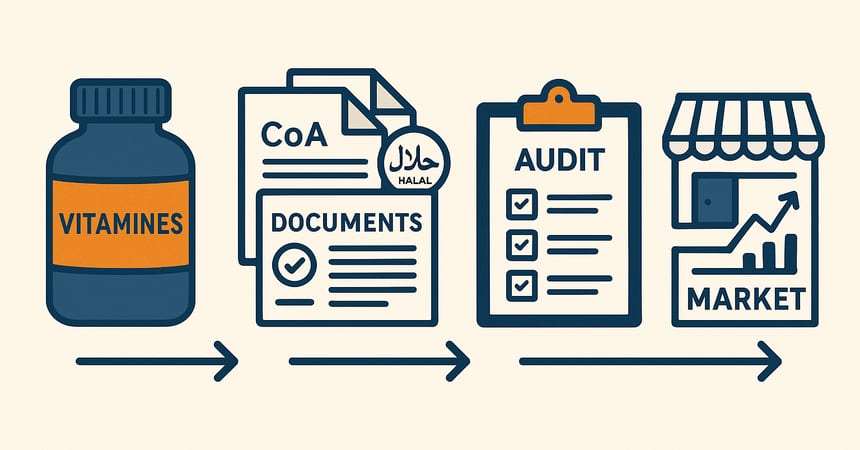
- Certificate of Analysis (CoA), for each batch, or on request.
- Clinical and toxicological study protocols, where applicable.
- Labelling and packaging mockups, in French and/or Arabic.
Item 6 is the one that follows from classification. A product positioned with a therapeutic claim moves toward the pharmaceutical route and picks up an evidence burden that a food-classified product does not carry.
For how the same classification question plays out for vitamins specifically, see registering vitamins and nutraceuticals in Morocco.
What should you settle before applying?
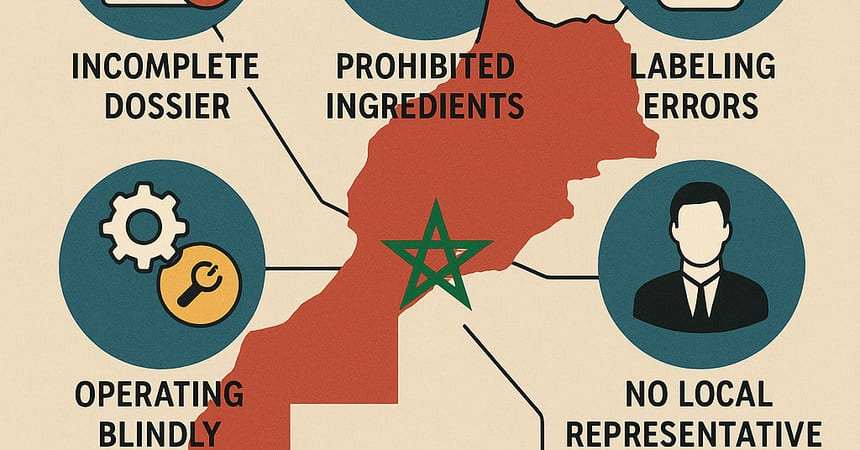
A local representative. Required to file the documents, under a contract with a local agent. Without a Moroccan legal entity there is no route to submit.
Prohibited ingredients. The product must not contain substances prohibited under Moroccan law, melatonin and certain stimulants among them. Substances permitted in the EU or the USA are not automatically permitted here.
Halal certification. May be required, particularly for retail distribution, and especially where the product contains animal-derived components.
Sources
- Ministère de la Santé et de la Protection Sociale, Morocco
- ONSSA, Office National de Sécurité Sanitaire des Produits Alimentaires
- IMANOR, Institut Marocain de Normalisation, halal certification
Frequently asked questions
Who regulates supplements in Morocco?
The Ministry of Health and Social Protection. ONSSA, the National Office for Sanitary Food Safety, may also be involved where the product falls into functional or food categories. Which body leads depends on how the product is classified.
Is a local representative required?
Yes. A local representative in Morocco is needed to file the documents, under a contract with a local agent. Attempting to register without a Moroccan legal entity leads to rejection or customs delays.
Not sure which of these applies to your product? Send it and we will tell you
Related articles
Six Mistakes Registering Supplements in Morocco
Ingredients legal in the EU but banned in Morocco, medical claims on labels, no local representative, and a four-month timeline people budget three weeks for.
Halal Certification for Supplements in Morocco
When a supplement needs a halal certificate, which international bodies IMANOR recognises, the documents required, and a 3 to 6 week timeline.
Registering Vitamins and Nutraceuticals in Morocco
No legal definition of nutraceutical exists, so classification decides everything: ONSSA or DMP, three to five months, and a mandatory local representative.