Does Your Product Need an Energy Efficiency Label?
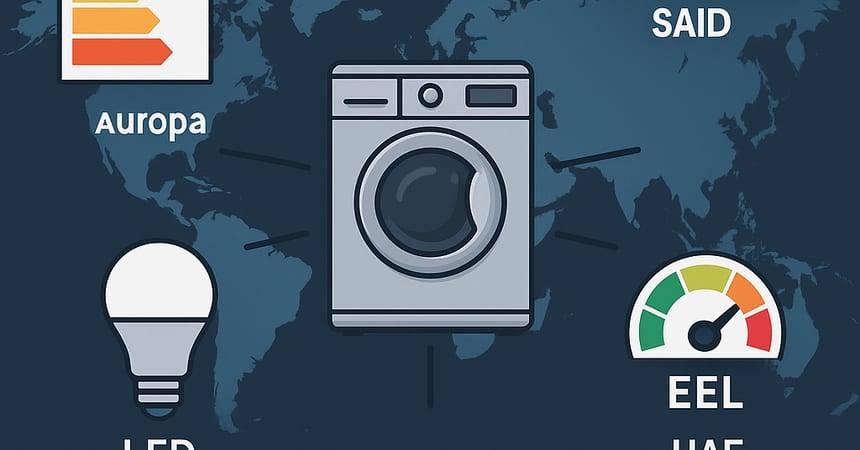
Energy efficiency labelling is a legal requirement in the EU, UAE, Saudi Arabia, South Korea, Kazakhstan and elsewhere. Whether a product needs one turns on five things, and the same product with the same specification can be exempt in one country and regulated in the next.
What is an energy efficiency label?
A label indicating how energy-efficient a product is, rated against defined performance criteria. It is mandatory in regions including the EU, UAE, Saudi Arabia, South Korea and Kazakhstan.
Each country runs its own classification system, but the intent is identical everywhere: only products that have been tested, rated and clearly labelled may go on sale.
Which products are regulated?
| Category | Examples |
|---|---|
| Home appliances | Refrigerators, air conditioners, washing machines, televisions, water heaters |
| Commercial equipment | Elevators, chillers, compressors |
| Lighting | LED lamps, luminaires |
| Office electronics | Monitors, printers, laptops, depending on jurisdiction |
The regulated list varies by country, and that variation is the whole difficulty. A product may be exempt in one country and require labelling in another with exactly the same technical specifications. Nothing about the product tells you the answer.
How do you check whether your product needs one?
Five inputs decide it:
- Target country or region.
- Product category, as it appears on that country’s official lists, not as your catalogue describes it.
- Applicable regulations and technical standards.
- Test results from accredited laboratories.
- Packaging and labelling requirements that follow from the rating.
Points 2 and 5 are where projects go wrong. A category mismatch means testing the wrong parameters; discovering the packaging requirement late means reprinting artwork that was signed off before the rating existed.
The sequence that avoids rework
Establish the category on the official list for each target market first. Only then commission testing, because the parameters tested have to match what that market’s classification uses. Produce packaging artwork last, once the rating is known.
Reversing any two of those steps costs a testing round or a print run.
Sources
- Regulation (EU) 2017/1369 setting a framework for energy labelling
- SASO, Saudi Standards, Metrology and Quality Organization, Energy Efficiency Label
- ESMA/MOIAT, United Arab Emirates energy efficiency labelling requirements
Frequently asked questions
Which products commonly require an energy efficiency label?
Home appliances such as refrigerators, air conditioners, washing machines, televisions and water heaters; commercial equipment including elevators, chillers and compressors; lighting, meaning LED lamps and luminaires; and office electronics, monitors, printers and laptops, depending on the jurisdiction.
Can the same product be exempt in one country and not another?
Yes, and this is the trap. A product may be exempt in one country and require labelling in another with identical technical specifications, because each country maintains its own regulated product list and its own classification system.
What determines whether a label is required?
Five things: the target country or region, the product category as it appears on the official lists there, the applicable regulations and technical standards, test results from accredited laboratories, and the packaging and labelling requirements that follow.
Not sure which of these applies to your product? Send it and we will tell you
Related articles
Belarus Energy Efficiency Standards: The 2020 Revision
Seven STB standards were reissued on 1 November 2020 with changes to structure, terms and definitions. No new testing was required.
Household Appliance Certification in the Gulf Countries
Safety to IEC and ISO, mandatory energy labelling, RoHS and recycling rules, local laboratory testing, and documentation in English and Arabic.
Electrical Safety Certification Across Markets
Plug types, voltages and labelling differ by country, and a European product often fails Middle East requirements. What to check before redesigning.