Pipe Certification Under TR CU 032: The Grey Area
TR CU 032/2013 does not apply to main, in-field or local distribution pipelines for gas, oil and other products, and, per Rostekhnadzor's 2018 explanations, not to their elements, connecting parts, fittings or safety devices either. Pipes used outside those systems are a different matter, and certification bodies do not agree on them.
What does TR CU 032 cover, and what does it exclude?
Rostekhnadzor issued explanations on this point in 2018, and they are the clearest statement available.
TR CU 032/2013 sets the uniform mandatory safety requirements for the design and manufacture of high pressure equipment within the scope defined in clauses 2 and 3, including its elements and assembly units, the components subjected to pressure, and fittings.
Clause 3 then excludes a large category:
| Excluded | Consequence |
|---|---|
| Main pipelines | Their elements and connecting parts are excluded too |
| In-field pipelines for gas, oil and other products | Same |
| Local distribution pipelines for gas, oil and other products | Same |
That second column is the part people miss. Because the pipelines themselves are outside the regulation, so are the equipment elements and connecting parts intended for use as part of them, flanges, bends, pipes, elbows and tees. Any fittings and safety devices used for those pipelines are likewise not subject to confirmation of compliance with TR CU 032.
Which pipes still fall under TR CU 032?
Pipes used outside main, in-field and local distribution pipelines. For those, the provisions of TR CU 032/2013 may well apply, but only after the details are established:
- The scope of application and the function of the pipeline the pipes are used in
- The class of the product
- The operating and design pressure for the pipes
- The internal diameter
- The type of operating medium
None of these can be inferred from the product alone. The same pipe can be in scope or out of it depending on the system it goes into.
Why do certification bodies disagree about pipes?
There are no GOST standards for this product type, and that gap has produced two settled positions.
- Some certification bodies conclude that without standards, such products are not subject to certification.
- Others insist certification is mandatory, on the grounds that pipes are elements of pipelines that fall under TR CU 032/2013.
Practice with the customs authorities settles the question in a less theoretical way: inspectors still require documents confirming compliance with TR CU 032/2013 during customs clearance of the cargo.
That is the risk to plan around. A defensible legal argument that the product is out of scope does not move a container that an inspector has stopped. The workable approach is an integrated evaluation that takes account of every feature of the product, made before the goods ship rather than after.
Sources
- TR CU 032/2013, On the safety of equipment operating under excessive pressure, Eurasian Economic Commission, clauses 2 and 3
- Rostekhnadzor explanations on the application of TR CU 032/2013, 2018
Frequently asked questions
Are pipeline parts covered by TR CU 032?
Not when they are intended for main, in-field or local distribution pipelines carrying gas, oil or other products. Rostekhnadzor's 2018 explanations confirm that because clause 3 excludes those pipelines, the exclusion carries to their elements and connecting parts, flanges, bends, pipes, elbows and tees, and to fittings and safety devices used on them.
What decides whether a pipe needs certification?
The pipeline it is used in. If it is used outside main, in-field and local distribution pipelines, TR CU 032/2013 may well apply. Determining that means looking at the scope and function of the pipeline, the class of the product, the operating and design pressure, the internal diameter, and the type of operating medium.
Why do certification bodies disagree about pipes?
Because there are no GOST standards for this product type. Some bodies conclude the products are therefore not subject to certification; others insist certification is mandatory, on the grounds that pipes are elements of pipelines covered by TR CU 032/2013. Customs practice sides with the second group.
Not sure which of these applies to your product? Send it and we will tell you
Related articles
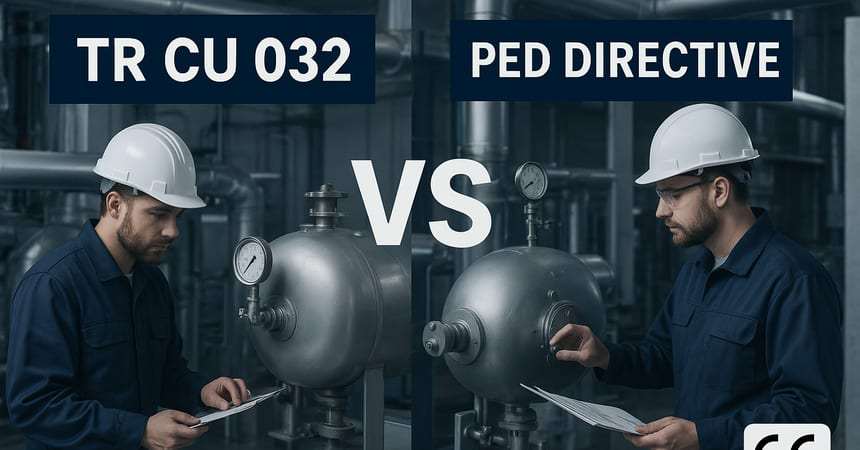
TR CU 032 vs the PED Directive: Two Philosophies
Both regulate pressure equipment safety, but one puts risk analysis on the manufacturer and the other prescribes the requirements. What that means in practice.
What Counts as Equipment Operating Under Excess Pressure
The 0.05 MPa threshold that makes equipment high-risk, the device types it captures, and why the purpose of the device has nothing to do with it.
Strength Calculation: Why TR CU 032 Will Not Move Without It
The strength calculation is a named document in TR CU 032. Which GOST standards govern it, why a foreign calculation is not accepted, and the language rule.