EAC Approval for Power Adapters and Chargers
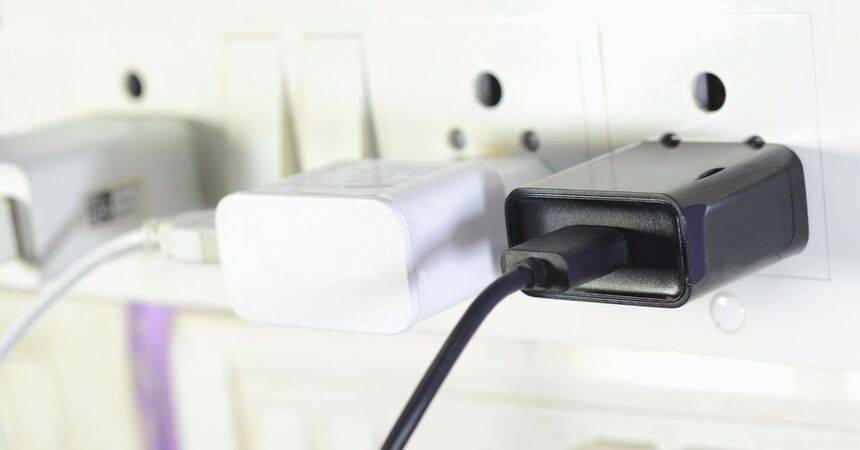
Adapters fall under three regulations. Low-voltage safety and electromagnetic compatibility are proved with a single certificate covering TR CU 004 and TR CU 020 together; restricted substances go on a separate declaration under TR EAEU 037, which can rest on existing manufacturer test reports.
Which regulations apply to adapters?
Adapters fall under three mandatory regulations for import into the Customs Union area:
| Regulation | Subject | Document |
|---|---|---|
| TR CU 004 | Safety of low voltage devices (LVD) | Certificate of Conformity |
| TR CU 020 | Electromagnetic compatibility (EMC) | Certificate of Conformity |
| TR EAEU 037 | Restriction of hazardous substances (RoHS) | Declaration of Conformity |
The first two are united in a single certificate. The third stands alone.
The certificate for TR CU 004 and 020
A certificate of conformity can be issued either for serial production, with one, three or five years’ validity, or for a single delivery, in which case it ceases to be valid once that delivery is complete.
The process runs in four steps:
- Application. The certification body prepares an application carrying the full technical data on the product, name, type, model, HS code, plus the manufacturer’s details and the applicant’s. Only a Customs Union-based company may act as applicant.
- Registration. Once the manufacturer checks and confirms the application, the applicant signs it and the certification body registers it. For a serial certificate, a site audit for the quality management system and sample selection is foreseen at this point.
- Audit and sampling. An expert from the certification body visits the production site, audits the production area and selects the samples for testing in a Customs Union laboratory. A QMS audit is not required for a batch certificate.
- Testing. Samples go to the laboratory; preliminary lead time is about two weeks. With a positive test report, the certificate can be registered.
The obligation that continues
All serial certificates are subject to annual inspection control. Each year within the certificate’s validity, new samples must be sent for testing and an inspection report prepared. An additional audit is sometimes required as well, to confirm that production quality has not drifted since initial registration.
This recurring cost belongs in the decision about whether to take a one-, three- or five-year certificate.
How is RoHS covered?
Comfortably simpler. TR EAEU 037 is covered by a declaration only, no audit, no mandatory sample testing.
The declaration can be issued on the manufacturer’s own RoHS test reports, for example from a European laboratory. Where no such report exists, samples go to a Customs Union laboratory instead, and RoHS testing can take up to a month, longer than the two weeks for the safety and EMC tests, which often makes it the item that determines when the project finishes.
What do both documents need?
An operating manual translated into the Union’s working language. Neither the certificate nor the declaration can be registered without it, and it is the single most common item to be left until last.
Sources
- TR CU 004/2011, On the safety of low-voltage equipment, Eurasian Economic Commission
- TR CU 020/2011, Electromagnetic compatibility of technical means
- TR EAEU 037/2016, On restriction of the use of hazardous substances in electrical and electronic products
Frequently asked questions
Is RoHS covered by the same certificate?
No. TR CU 004 and TR CU 020 are united in one certificate of conformity, which requires a site audit and sample testing. TR EAEU 037, RoHS, is covered by a declaration only, and that declaration can be issued on the manufacturer's own RoHS test reports, for instance from a European laboratory.
What does the annual inspection involve?
Every serial certificate is subject to annual inspection control: within the certificate's validity, new samples must be sent for testing each year and an inspection report prepared. Sometimes an additional audit is also required, to confirm production quality is unchanged since the certificate was first registered.
How long does RoHS testing take?
Up to a month, if samples have to be sent to a Customs Union laboratory because no suitable manufacturer report exists, which is longer than the two weeks typical for the safety and EMC tests. It is often the item that sets the critical path.
Not sure which of these applies to your product? Send it and we will tell you
Related articles
EAC Approval for HVAC Systems: Household vs Industrial
Household HVAC needs certificates under TR CU 004 and 020 plus a RoHS declaration. Industrial HVAC needs none of that, it declares under 004, 020 and 010.
EAC Certification of Lighting Fixtures and Equipment
Three technical regulations apply to lighting, certification runs on schemes 1c, 3c or 4c, and the test standards differ by fixture type.
Writing Operating Manuals for TR CU 004 and TR CU 020
The mandatory contents of an operating manual under each regulation, the language rule, and when an electronic-only manual is permitted.