Food and Beverage Certification in Israel
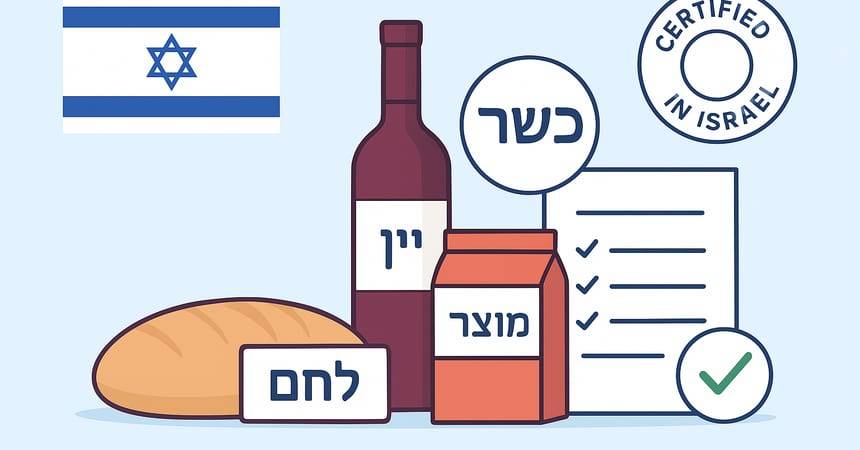
Israel regulates food through three bodies: the Ministry of Health for sanitary standards, the Standards Institution for testing, and the Chief Rabbinate for kosher status. Hebrew labelling is mandatory, and kosher certification, though not legally required, decides whether supermarkets will stock the product.
Who regulates food in Israel?
The Israeli food and beverage market is competitive and strictly regulated, with particular attention to safety, quality and transparency. Three bodies share oversight:
| Authority | Responsibility |
|---|---|
| Ministry of Health (MOH) | Sanitary standards, safety, registration of new product categories |
| Standards Institution of Israel (SII) | Develops and enforces standards, conducts laboratory testing |
| Chief Rabbinate of Israel | Certifies products applying for kosher status |
For a foreign manufacturer, certification is not a formality: without it, products are not allowed for sale.
What are the mandatory requirements?
1. Sanitary compliance. Laboratory tests for pathogens, chemicals and pesticides, plus shelf life and storage conditions.
2. Labelling in Hebrew. Product name, full composition, nutritional values, allergens, country of origin, expiration date, storage conditions, and kosher status where applicable.
3. Kosher certification. Not legally mandatory, and commercially close to essential, because most supermarket chains refuse non-kosher products. Issued under the supervision of the Chief Rabbinate.
4. Import procedures. Importers provide a certificate of compliance, proof of origin, Hebrew translations, and MOH approval.
How does Israel differ from the EU and the USA?
- Hebrew labelling is mandatory. It is a condition of sale.
- Foreign kosher certificates are not always automatically recognised. Holding one from another jurisdiction does not settle the question.
- Approvals take longer, because both religious and sanitary inspections are involved.
Practical advice for foreign companies
- Start certification at least 3 to 6 months before entering the market.
- Clarify which type of kosher certificate is required, before commissioning it.
- Work with accredited laboratories in Israel, or with recognised partners.
- Prepare packaging and documentation in Hebrew in advance, before approval.
The last point is the one that most often adds a print run. Hebrew label content depends on the composition and nutritional data that testing confirms, so artwork finalised before the results exist is artwork that will change.
Sources
- Israeli Ministry of Health, food import and registration requirements
- SII, Standards Institution of Israel
- Chief Rabbinate of Israel, kosher certification
Frequently asked questions
Is kosher certification legally required in Israel?
No, but in practice it is decisive. Most supermarket chains refuse non-kosher products, so a manufacturer without it is excluded from mainstream retail regardless of compliance. Certification is issued under the supervision of the Chief Rabbinate of Israel.
What must the label show?
In Hebrew: product name, full composition, nutritional values, allergens, country of origin, expiration date, storage conditions, and kosher status where applicable. Unlike the EU and USA, Israel makes Hebrew labelling mandatory.
How early should certification start?
Three to six months before entering the market. Approvals can take longer than elsewhere because both religious and sanitary inspections are involved, and foreign kosher certificates are not always automatically recognised.
Not sure which of these applies to your product? Send it and we will tell you
Related articles
Certificates for Agricultural Suppliers to Israel
Phytosanitary, agrochemical, veterinary, food quality, kosher and environmental, six certificate families, three regulators, and a 2 to 6 month lead time.
Food Certification in China: GACC Registration
Registering on the GACC platform, the certificates needed before you can, local quarantine testing, Chinese labelling and the eight documents customs asks for.
Halal, Kosher and National Standards in the GCC
Halal opens the market and national certification makes the product legal. Neither substitutes for the other, and customs checks both.